An eight-millimetre septum lets the needle through and is tight again afterwards. It must give nothing to the sample, or the chromatogram shows peaks that did not come from the sample. Silicone on its own gives off too much, which is why PTFE goes on top.
- Home
- Applications
Moulded rubber parts and technical seals
Aggressive media, high temperatures or food contact: every application puts its own demands on the material. All the more so when parts are barely accessible once installed. We choose the right elastomer compound, adapt it or develop a new one. The properties that matter we document with the necessary testing and certification.
Five applications, from blood analysis to the building wall
01
Septa and puncture seals
02
Valve seals in thermal management
Four-way valves control the cooling circuit for battery, drivetrain and cabin in electric vehicles. The seal faces coolant, pressure and constant temperature cycling, over the life of the car. Supplied to Tier 1 through Tier 3.
03
Wall penetration seals
It sits in the masonry from the moment the building stands, and nobody can reach it afterwards. For systems like these we supply the rubber element: a compound that stays tight for the life of the building and bonds to steel.
04
Cable seals
Cables, conduits and fibre run through the same opening in the building wall. The seal keeps water out and gas in, over the life of the building.
05
Technical seals
Not every seal has a name of its own. Many parts are defined purely by medium, temperature and pressure: flat gaskets in plant engineering, cover and flange gaskets, seals to drawing. Supplied as a cut part or as a moulded part.
Cut part or moulded seal: which one pays off for you?
A flat gasket can be cut from a sheet or formed in a tool. Cutting needs no tooling and is often the more economical route at low volumes. Depending on the geometry, though, it leaves offcuts that you pay for. A moulded part means tooling costs up front, but the material input can be matched far more closely to the part. Which option pays off for you depends on geometry, material and volume. We work that out with you before you order.
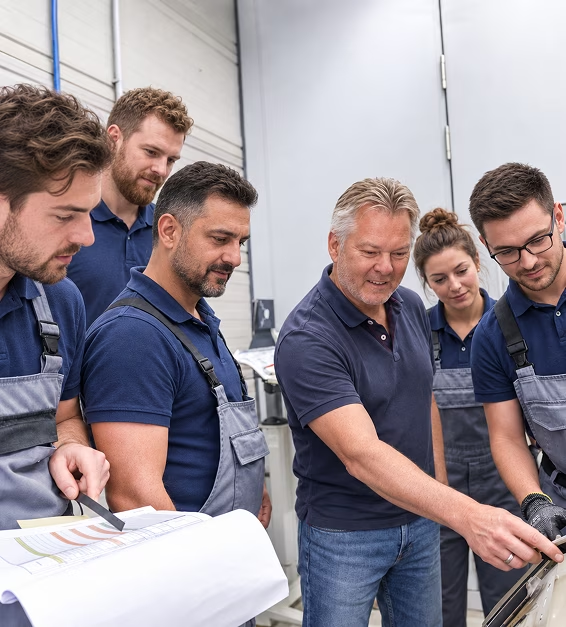
Agreed once, reliable from then on.
Before we deliver for the first time, we define together what your material has to do: from hardness and temperature range to the resistances you need. You then test the sample under your actual operating conditions, which shows whether it meets your requirements in practice too. The agreed values remain the benchmark for every further batch. So that the twentieth delivery is the same grade as the first.
What comes with every delivery
Sample before the series
From the plant that will later run the series.
Test report
On request, measured against the values agreed beforehand.
Batch traceability
For every roll and every sheet we keep a record of which batch it came from.
ISO 9001
Certified at TRIWES, and at the partner plants too.
For us, TRIWES is more than a business partner. The collaboration is personal, reliable and solution-oriented, especially when things don't go by the book.
Head of Sales at a technology partner for pharmaceutical and analytical applications
Technologiepartner für Pharma- und Analytikanwendungen
The material behind every application
Whether a septum must give nothing off or a wall penetration seal has to last thirty years: it is decided by the material. Eight families to choose from, each with hardness, temperature range and the certifications that exist for it.
Where these applications are needed
A sealing disc in the laboratory and a wall penetration seal in a shell building have little in common, apart from the question of which certification is asked for in the end. Five industries, each with its own requirements, and the right grade for every one.
What problem should we solve?
Heat-resistant grades, media-resistant compounds, shapes to drawing or to sample: we supply those too. If your job is not listed here, describe it to us in two sentences.